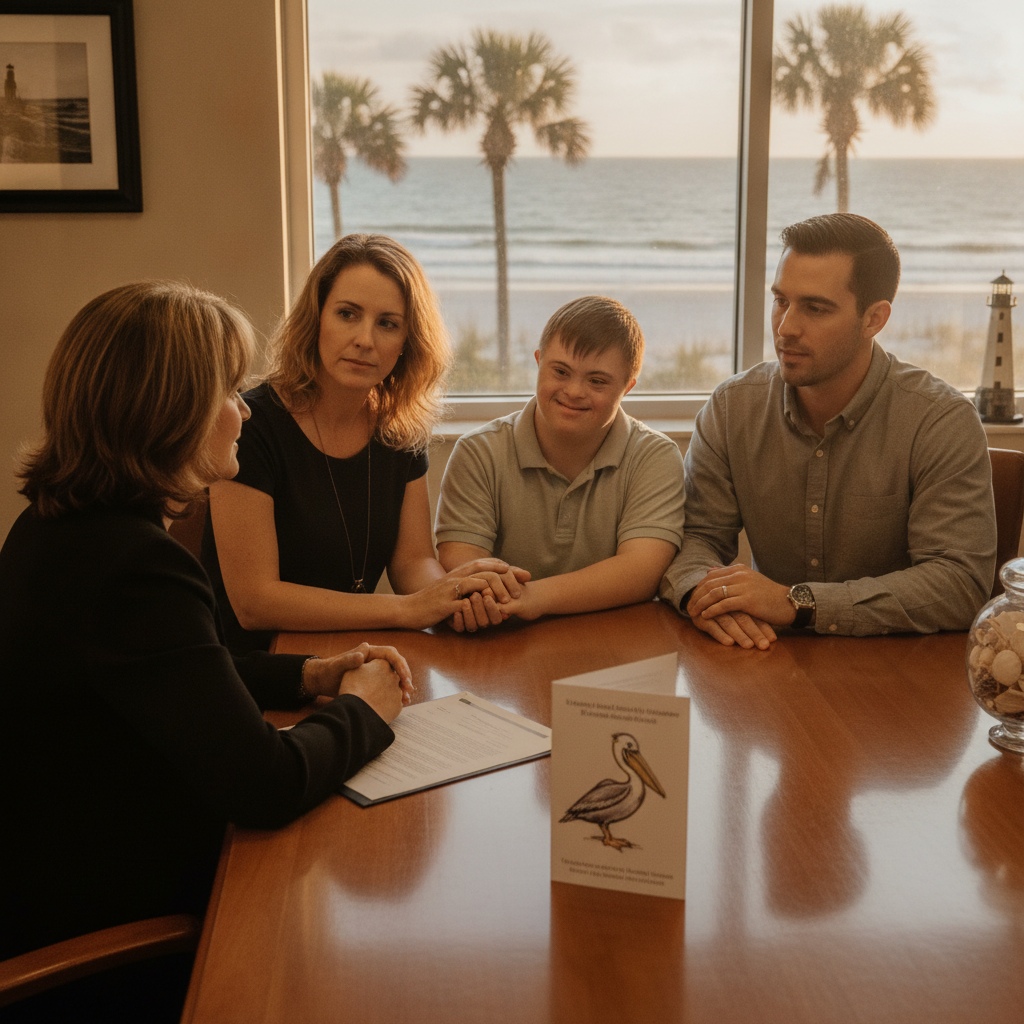
How Should Orange Beach and Gulf Coast Families Handle Estate Planning for a Special Needs Child or Dependent Adult?
If you have a child or dependent adult with a disability — whether that’s a developmental condition, a physical impairment, or a serious mental health diagnosis — leaving them a direct inheritance through a standard will can actually cause real harm. In Orange Beach and across Baldwin County, families in this situation need a different kind of estate plan: one built around a special needs trust that protects their loved one’s financial future without cutting off access to the government benefits they depend on every day.
This is one of the most important and most frequently overlooked corners of estate planning. Most general estate planning guides — and unfortunately, most generic online tools — don’t address it with any meaningful depth. Here’s what you need to know.
Why a Standard Will or Direct Inheritance Can Backfire
Many Gulf Coast families assume that leaving money directly to a child or sibling with a disability is a straightforward act of love and protection. In reality, it can trigger an immediate loss of eligibility for Supplemental Security Income (SSI) and Medicaid — two programs that provide not just income, but healthcare, housing support, and access to critical services.
Both SSI and Medicaid are needs-based programs. They have strict asset limits — generally $2,000 in countable resources for an individual. If your dependent receives an inheritance of any significant size and that money goes directly to them, it counts as a resource. Their benefits can be suspended or terminated until those funds are spent down to the program threshold. That’s not a safeguard — it’s a trap that well-meaning families fall into without realizing it.
The same problem can arise when a well-meaning relative names a special needs family member as a direct beneficiary on a life insurance policy, a retirement account, or a payable-on-death bank account. The inheritance flows directly to the individual, and the benefit eligibility clock starts ticking.
What a Special Needs Trust Actually Does
A special needs trust — sometimes called a supplemental needs trust — is a legal structure designed to hold assets for the benefit of a person with a disability without those assets counting against their government benefit eligibility. The trust owns the assets, not the individual. Because the individual doesn’t have direct control or ownership of the funds, SSI and Medicaid generally do not count them as resources.
The trustee — the person or institution you name to manage the trust — can use trust funds to pay for things that government programs don’t cover: a computer, recreational activities, travel, personal care items, educational courses, or adaptive equipment. The goal is to supplement what benefits provide, not replace them. That’s the core logic of the whole structure, and it’s reflected right in the name.
There are a few different types of special needs trusts, and the right one depends on where the money is coming from and who is creating it:
- Third-party special needs trusts are created and funded by someone other than the person with the disability — typically a parent, grandparent, or sibling. These are the most common type used in estate planning. When the beneficiary passes away, any remaining assets can go to other family members or heirs.
- First-party (self-settled) special needs trusts are funded with the disabled person’s own assets — often from a personal injury settlement or an inheritance that was received directly before the trust was established. These trusts have a payback provision: when the beneficiary dies, Medicaid may recover its costs from what remains in the trust.
- Pooled trusts are managed by nonprofit organizations and pool resources from multiple beneficiaries for investment purposes, while maintaining separate accounts for each individual.
For most Orange Beach families doing proactive estate planning, a third-party special needs trust is the right tool — created now, integrated into your overall estate plan, and funded either during your lifetime or at your death through your will, life insurance, or retirement account beneficiary designations.
Choosing the Right Trustee — and Why It Matters More Than People Realize
The trustee of a special needs trust carries significant responsibility. They must understand how the trust works, know what expenditures are permissible versus prohibited under SSI and Medicaid rules, keep proper records, and act consistently in the beneficiary’s best interest — potentially for decades.
Many families name a sibling or close relative as trustee. That can work well, but it comes with risks: the named individual may predecease the beneficiary, become incapacitated themselves, or simply lack the financial or legal literacy to manage the trust correctly over time. A poorly administered special needs trust can cost the beneficiary their benefits just as surely as a direct inheritance would.
Options worth considering include co-trustees (pairing a family member with a professional trustee or corporate trustee), a professional fiduciary, or a trust department at a financial institution. The right answer depends on the size of the trust, the complexity of your loved one’s needs, and your family dynamics. This is exactly the kind of nuanced conversation that a local wills and trusts attorney should walk you through before you finalize anything.
How This Fits Into Your Broader Estate Plan
A special needs trust doesn’t exist in isolation — it has to be coordinated with everything else in your estate plan. That means reviewing and updating beneficiary designations on life insurance policies and retirement accounts so those assets flow into the trust rather than directly to your dependent. It means making sure your will or revocable living trust directs the right assets into the right place. And it means talking with other family members — grandparents, aunts and uncles — so they don’t inadvertently leave money directly to your dependent in their own estate plans.
For families in Fairhope, Daphne, Foley, Mobile, or anywhere else along the Gulf Coast who split time between Alabama and another state, there’s an additional layer of complexity. Medicaid rules vary by state, and if your dependent receives care in one state and you’re a snowbird or multi-state resident, you may need to think about how different state rules interact. That’s not something a DIY estate planning tool handles well — or at all.
Getting your overall estate plan structured correctly from the start is far easier and less costly than unraveling a mistake after the fact.
A Gap Most Local Competitors Don’t Address
Special needs planning is one of those topics where many general estate planning and probate websites in this area offer surface-level information at best — a paragraph or two that mentions special needs trusts exist without explaining how they work, what they cost, who should serve as trustee, or how they connect to the rest of an estate plan. That leaves Gulf Coast families searching for real answers and often finding nothing locally specific.
The reality is that this kind of planning is not a niche add-on to estate planning — it’s a critical component for any family with a disabled dependent, and it requires someone who understands both Alabama law and the federal benefit rules well enough to get the structure exactly right. One drafting mistake in a special needs trust can have consequences that last for the rest of your loved one’s life.
Frequently Asked Questions
Can I just leave money to another child and ask them to take care of their sibling?
Some families try this as an informal workaround — leaving an inheritance to a non-disabled sibling with the expectation they’ll use it for their brother or sister’s care. It’s legally risky and emotionally complicated. The money becomes that sibling’s asset, subject to their creditors, their divorce proceedings, or their own estate if they die. There’s no legal obligation to use it for your dependent. A properly drafted special needs trust is a far more reliable approach.
Will a special needs trust affect my dependent’s Medicaid or SSI right away?
No — creating a third-party special needs trust does not affect current Medicaid or SSI eligibility. The trust only becomes relevant when assets are placed in it or when your dependent receives an inheritance or gift through it. Because those assets are owned by the trust rather than the individual, they generally don’t count against benefit eligibility thresholds.
What happens to the trust when my dependent passes away?
With a third-party special needs trust, you decide who receives the remaining assets after your dependent dies. It could be other children, grandchildren, or a charitable cause. Unlike a first-party (self-settled) trust, there is no Medicaid payback requirement for third-party trusts — the assets pass to the beneficiaries you designated.
How much does it cost to set up a special needs trust in Alabama?
Costs vary depending on the complexity of your situation, the size of the estate, and how the trust integrates with the rest of your plan. This is not a document you want to draft using an online template — the stakes are too high and the rules too specific. Contact The Bales Lawfirm directly for a consultation to discuss what your family’s situation requires.
We live in Orange Beach but spend winters in Florida — does that create any complications?
It can. Medicaid is administered state-by-state, and each state has its own rules about eligibility, covered services, and how trusts are treated. If your dependent receives services or care in both Alabama and Florida, or if you’re considering changing your legal domicile, these are important factors to address with an attorney who understands multi-state planning for Gulf Coast families.
Talk to The Bales Lawfirm About Protecting Your Dependent’s Future
Planning for a child or dependent adult with a disability is one of the most meaningful things you can do as a parent or caregiver — and one of the most consequential to get right. The Bales Lawfirm works with Orange Beach and Gulf Coast families to build estate plans that protect vulnerable loved ones without cutting off the benefits they depend on.
Whether you’re starting from scratch, updating an existing plan, or concerned that a family member may have inadvertently left assets in a way that could cause problems, we’re ready to help you think it through clearly and put the right structure in place. Contact us to schedule a consultation and get a straightforward conversation about what your family’s situation calls for.