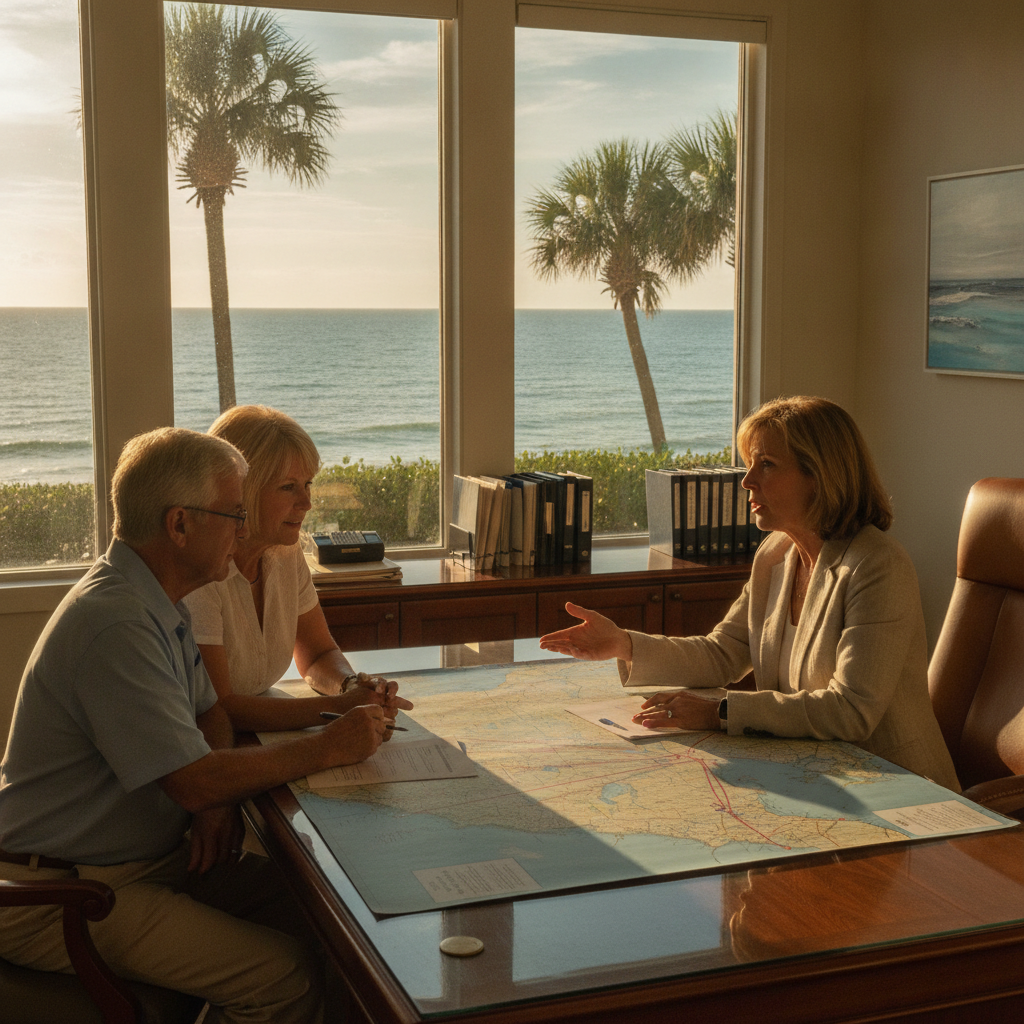
What Should Gulf Shores and Baldwin County Snowbirds Know About Coordinating an Estate Plan Across Two States?
If you split your year between Gulf Shores or Orange Beach and a home up north — whether that’s Ohio, Michigan, Illinois, or anywhere else — your estate plan has to work in both places. A will or power of attorney that’s perfectly valid in Alabama may create confusion, delays, or even legal complications in your northern state, and vice versa. This isn’t a rare edge case. It’s one of the most common planning gaps we see among seasonal residents along the Gulf Coast, and it’s a problem that’s easy to fix when you get ahead of it.
Why Snowbirds Face Unique Estate Planning Challenges
Alabama has become a genuine retirement destination. Baldwin County — including Gulf Shores, Fairhope, Daphne, and Foley — sees a significant influx of seasonal residents every fall who plan to stay through spring. Many own condos, waterfront property, or vacation homes here. Some have purchased on the Gulf Coast specifically as a retirement transition, intending to eventually make Alabama their permanent home. Others maintain true dual residency for years, keeping property and legal ties in both states.
That dual-state reality creates real legal complexity. Here’s why it matters for your estate plan:
- Each state has its own probate laws. If you own real property in Alabama and your will was drafted in another state, Alabama courts will still apply Alabama probate law to that property. That can mean a process your family didn’t expect and wasn’t prepared for.
- Powers of attorney aren’t always portable. Alabama has specific statutory requirements for durable powers of attorney. A document drafted under Ohio or Michigan law may not be accepted by an Alabama bank, title company, or healthcare provider without question — and during a crisis, that friction costs time.
- Healthcare directives vary by state. What constitutes a valid advance directive or living will differs from state to state. If you’re hospitalized in Gulf Shores and your healthcare directive was drafted for Illinois, medical providers may not be confident accepting it.
- Domicile determines which state governs your estate. If you haven’t clearly established Alabama as your legal domicile — or intentionally maintained it elsewhere — there can be disputes about which state has authority over your estate at death.
The One Tool That Solves Most Multi-State Problems: A Revocable Living Trust
For snowbirds with property in more than one state, a revocable living trust is almost always the most practical solution. When your real estate is titled in the name of your trust rather than in your personal name, it doesn’t have to pass through probate in either state at your death — regardless of where you own property.
That matters enormously for families. Without a trust, your family could face separate probate proceedings in Alabama and in your northern home state — two different courts, two different timelines, two sets of legal fees. A properly funded revocable living trust eliminates that double-probate scenario entirely. Assets held in the trust pass to your beneficiaries according to the trust’s terms, governed by the state you designate, without court involvement.
This is why many Gulf Coast residents with property in multiple states — or those who divide their time between Perdido Key and the Florida Panhandle as well as a northern state — find that getting a trust in place is one of the most valuable steps they can take. You can learn more about how this works on our wills and trusts page.
What Snowbirds Often Overlook: Domicile and State Income Tax
This is the section that most local competitors don’t address clearly — and it’s one of the most consequential issues for seasonal Gulf Coast residents.
Your legal domicile — the state you claim as your permanent home — determines far more than where you file your taxes. It determines which state’s laws govern your will, which state can probate your estate, and in some cases which state can assess estate or inheritance taxes on your assets. Alabama does not have a state estate tax or an inheritance tax. Several northern states do. For a high-net-worth snowbird with significant assets, establishing Alabama domicile before death can meaningfully reduce what heirs owe.
But establishing domicile isn’t as simple as spending more nights in Gulf Shores than in Cleveland. Courts look at a pattern of intent-based actions: Where is your primary residence registered? Where are you registered to vote? Where do you hold your driver’s license? Where do you bank? Where do you attend religious services, maintain club memberships, or keep your most important personal property? If you haven’t taken concrete steps to establish Alabama domicile, your former northern state may still claim jurisdiction — and tax authority — over your estate.
An estate plan for a true snowbird needs to address domicile directly, not leave it to chance.
State-Specific Documents You May Need
Even with a trust in place, you’ll likely need certain documents drafted or reviewed under Alabama law if you spend significant time here. These include:
- An Alabama Durable Power of Attorney — so a trusted person can manage your finances and property here if you’re incapacitated, without fighting over whether an out-of-state document is valid
- An Alabama Advance Directive for Health Care — governing your medical wishes if you’re hospitalized at Thomas Hospital in Fairhope, South Baldwin Regional in Foley, or another local facility
- A Pour-Over Will executed in Alabama — a safety-net document that directs any assets outside your trust into it at death, executed according to Alabama’s witnessing and notarization requirements
None of these are complicated to put together, but each needs to be properly executed under Alabama law to be immediately useful when it matters. You can see the full scope of what a comprehensive Alabama estate plan includes on our estate planning services page.
Why Generic Online Tools Fall Short for Snowbird Situations
Snowbird estate planning is exactly the kind of situation where a one-size-fits-all online document tool breaks down. Those platforms don’t ask whether you own property in two states. They don’t analyze your domicile situation. They don’t flag that your existing northern-state power of attorney might not be accepted by an Alabama financial institution. They produce a document — but not a coordinated plan.
If your circumstances span two states, your planning needs to account for both. That requires an attorney who understands Alabama law and who can either coordinate with your northern-state attorney or help you structure documents that hold up in both jurisdictions.
Frequently Asked Questions
If I already have a will from my home state up north, do I need a new one in Alabama?
Not necessarily — Alabama generally recognizes wills validly executed in other states. But if you own real property in Alabama, it’s worth having an Alabama attorney review your existing documents to confirm they’re structured in a way that won’t create unnecessary probate complications here. A revocable living trust may eliminate this issue altogether.
How do I officially change my domicile to Alabama?
There’s no single form to file. Changing domicile requires a consistent pattern of action: getting an Alabama driver’s license, registering to vote here, updating your address with financial institutions, and filing a Declaration of Domicile if you’re dealing with a state like Florida that has a formal process. An attorney can help you document the steps that matter most for your specific situation.
Does Alabama recognize healthcare directives from other states?
\p>Alabama law generally allows healthcare providers to honor advance directives from other states, but it’s not guaranteed in every clinical context. Having an Alabama-compliant directive in place gives medical staff clear, unambiguous guidance — especially in an emergency.
What happens to my Gulf Shores condo when I die if it’s still in my personal name?
It would pass through Alabama probate — a court-supervised process that takes time and money and becomes a matter of public record. Transferring the condo into a revocable living trust now sidesteps that entirely and lets your family handle the transfer privately and efficiently.
Can The Bales Lawfirm coordinate with my attorney up north?
Yes. We work with clients who have existing relationships with estate planning attorneys in other states and are happy to collaborate, review out-of-state documents, or handle the Alabama-specific components of a broader multi-state plan.
Get Your Gulf Coast Estate Plan Working the Way It Should
If you own property in Gulf Shores, Orange Beach, or anywhere along the Baldwin County coast and you also maintain ties to a northern state, your estate plan deserves a close look. The right structure protects your family from multi-state probate, keeps your documents legally effective wherever you are, and makes sure your intentions are carried out clearly — no matter where you happen to be when something happens.
The Bales Lawfirm works with snowbirds and seasonal residents throughout the Gulf Coast to build estate plans that hold up on both ends of the trip. Reach out to schedule a consultation and we’ll help you figure out exactly what your situation calls for.